Standards are essential for ensuring quality and are the cornerstone of interchangeability. The history of standards dates back thousands of years. In the ancient world, people already standardized measures, weights, proportions in building elements, and many other aspects of daily life. The Industrial Revolution elevated standardization to new levels, making interchangeability in manufacturing possible. Specifications such as the Whitworth thread system and the first railway norms, which were eventually adopted globally, originated during this epoch. The 20th century saw the widespread adoption of standards across various fields and the establishment of national and international standards organizations. Naturally, cutting tool manufacturing was no exception to this progression; like other branches of industry, it embraced existing standards and contributed to the development of new ones.
The introduction of the first replaceable carbide inserts dates to the late 1940s. During this period in the USA, tool designers utilized a new concept: a tool holder with an insert pocket in which a replaceable "throwaway insert" was secured. The term "throwaway insert" reflected the fact that these inserts were intended to be disposed of after use.
Several years later, innovation gained momentum in Europe, where significant improvements were made. These advancements paved the way for a variety of new designs that revolutionized the cutting tool industry. Over time, the replaceable inserts began to be called "indexable inserts," a name that emphasizes their key advantage: the ability to rotate or replace a worn cutting edge, ensuring the insert could be used fully before removal from service. Accordingly, tools designed for these inserts became known as "indexable tools."
The need to standardize carbide inserts catalyzed the introduction of ISO 1832 standard by the International Organization for Standardization (ISO), with the first version issued in the late 1970s. This standard established a system of letters and numbers to specify an insert’s shape, accuracy, clamping method, dimensions, cutting edge condition, and other parameters. Inserts that fully comply with ISO 1832 are known as "ISO standard inserts," or simply "ISO inserts."
However, ISO 1832 does not cover all types of indexable inserts. Some, such as threading or parting inserts, fall outside the scope of the standard. Others may use the standard’s identification system of letters and numbers but possess sizes not defined within ISO 1832. Furthermore, advancements in engineering and technology have resulted in the development of more complex insert shapes that are not included in the standard.
Despite these limitations, ISO inserts remain widely represented in the product portfolios of various tool manufacturers and are still in high demand, especially for turning applications. This popularity has even introduced the term "ISO turning," which refers to turning tools designed to use ISO inserts.
ISO inserts offer a wide range of advantages. Beyond the already-mentioned interchangeability, which is highly important for the simple replacement of inserts, the ability to use and compare inserts from different manufacturers, and reducing the stock of tool bodies, the ISO standard enables a common language for insert designation, avoiding possible misunderstandings. This universality makes insert identification open and widely understood, facilitating correct application and predictable work parameters. As a result, ISO inserts help to reduce production costs while ensuring that new and old tools can work together effectively.
At the same time, ISO 1832 is not without its disadvantages. It does not fully specify important characteristics of inserts, such as chip-forming surfaces, and it can create barriers to further innovation. Most notably, it does not define a digital representation for inserts, which is increasingly important in today’s manufacturing environment (this limitation accelerated the development of the ISO 13399 standard in the 2000s, designed to address the new requirements).
Introducing ISO 1832 has led to the production of many inserts by different tool manufacturers, all designed to meet the standard’s requirements. These inserts come in a variety of shapes (parallelogram, pentagon, rhombus, round, triangle, etc.) and defined sizes, and they can be interchangeably mounted in the appropriate pockets of various tools.
However, how can customers select the most effective insert for a specific operation? If we set aside the price factor and focus on cutting capabilities, what are the differences that make one insert perform better than another?
Indeed, while ISO 1832 specifies the insert’s shape, accuracy, clearance angle (i.e., the inclination of the side face relative to the rake face), cutting edge length, and other parameters, it does not define the rake face topology or the grade of the hard material used. Therefore, higher performance within the framework of the ISO standard is achieved through advancements in rake face design, cutting material, and technological quality. Moreover, it turns out that the seemingly simple design of an insert pocket has not yet exhausted its potential and continues to offer new prospects for enhancement. These attributes are where tool manufacturers can innovate and improve performance, even within the strict limitations set by the standard.
The perspective described above characterizes ISCAR’s latest ISO turning products.
The Standard's Constraints Are No Obstacle for Innovative Solutions
The triangular, double-sided LOGIQ-6-TURN inserts, introduced by ISCAR in recent years, are mounted in standard insert pockets of typical ISO turning tools designed for TNMG inserts. Like the TNMG, these new inserts also feature six cutting edges. However, two key design decisions, a 55-degree corner and an advanced chip breaker on the insert’s rake face, enable the successful application of LOGIQ-6-TURN inserts for semi-finishing and finishing operations (Fig. 1). This makes them a valuable alternative to 55-degree corner rhombic DCMT inserts with two cutting edges and 60-degree corner, triangular, one-sided TCMT inserts with three cutting edges.
The high surface quality achieved on machined parts, combined with six usable cutting edges, allows for more efficient use of carbide, whose price has risen substantially in recent times, and provides compelling advantages for customers.
Cartridges For Versatility and Preventing Tool Damage
Many advanced turning tools feature highly engineered designs: complex internal channels for effective coolant delivery, integral polygonal taper shanks to maximize rigidity, and enhanced insert clamping mechanisms to improve reliability, among other solutions. This increases not only the tool's cost but also its exposure to damage resulting from insert breakage. Despite continuous efforts to improve cutting material grades and insert geometries, preventing tool failure due to insert fracture remains a challenge.
Introducing exchangeable cartridges that carry the inserts offers a practical solution to this problem. In the event of insert breakage, only the damaged cartridge needs to be replaced - at a significantly lower cost. Furthermore, cartridges offer greater versatility by allowing inserts of different shapes to be mounted on the same tool.
The cartridge concept is realized in the CER-M-TURN family of turning tools, which utilize indexable ISO inserts of round, square, and rhombic shapes, particularly those made from cubic boron nitride (CBN) and ceramics (Fig. 2). A diverse range of tool configurations, including the options with square shank and polygonal taper shank according to the ISO 26623 standard (ISCAR's CAMFIX line), provides a wide variety of solutions to meet specific machining needs.
New Cutting Material Grades for Machining Difficult-To-Cut Materials
ISCAR’s turning inserts for hard materials are designed to help manufacturers Recently, two new PVD-coated carbide grades have been added to the already broad range of cutting materials for ISO inserts.
One of these, IC1024 (ISO H05-H10 application group), is designed for machining hard steel and cast iron with hardness up to HRC 62. This grade, which offers high deformation resistance, provides a cost-effective alternative to CBN and ceramic cutting materials.
Another, the IC706 carbide grade (ISO S10-S25), was developed specifically for machining titanium, particularly in semi-finishing and finishing operations. The combination of a hard submicron substrate and a titanium diboride (TiB2) coating results in excellent wear resistance and durability against plastic deformation.
In addition, ISCAR has significantly expanded its program of cutting ceramics by introducing an entire group of new ceramic grades.
The "Near-To-ISO" Approach as a Starting Point for Innovation
As previously mentioned, ISO 1832 does not fully standardize all inserts, even within shared shape categories. Furthermore, modern manufacturing advancements have introduced insert forms that resemble standard profiles but differ significantly in dimensions and side-surface (flank) geometries. Consequently, the rigid boundaries of ISO 1832 have prompted a wide array of "near-to-ISO" designs. Such designs utilize proprietary, close-to-standard inserts that are incompatible with conventional ISO pockets. This shift toward custom-engineered geometries represents the primary path of development in indexable turning among leading tool manufacturers.
A prime example is ISCAR’s DOVE-IQ-TURN family, which features highly economical, double-sided pentagonal inserts with 10 indexable cutting edges (Fig. 3). The insert’s specialized peripheral profile enables secure dovetail clamping in the pocket for exceptionally rigid locking. This single insert serves two distinct operations: high-feed roughing in a tool holder with a 14.5° entering angle, and rough-to-medium turning in a holder with a 55° entering angle.
Similarly, the XNMG rhombic insert of ISCAR's NEOTURN family utilizes a 70° nose (corner) angle (Fig. 4) that lies outside the standard ISO 1832 specification. Positioned between standard CNMG (80° nose angle) and DNMG (55° nose angle) inserts, this 70° geometry delivers greater profiling flexibility than a CNMG, alongside superior corner strength compared to a DNMG.
The MINI-P-TURN family, intended mainly for turning hard steel and cast iron (Fig. 5), presents another good example. The family’s double-sided, six-edged "near-to-ISO" trigon insert is notable not only for its CBN tips, which are secured using advanced brazing technology, but also for its specially formed side-surface geometry. The differently inclined sections of the insert's flanks ensure the necessary clearance angles while simultaneously serving as locating faces for rigid clamping in a matching dovetail pocket.
Digital Twin as an ISO-Turning Companion
Modern industry is steadily transitioning toward smart manufacturing, which strictly requires the digital representation of physical production objects. Despite being relatively small components of a complete machining system, ISO-standard turning inserts and tools are no exception to this trend. While the ISO 1832 standard successfully regularized physical inserts to ensure interchangeability and guide future design developments, new digital demands have prepared the ground for the ISO 13399 standard. This standard represents ongoing collaborative efforts to establish a unified digital language by specifying computer-interpretable representations of cutting tools.
ISCAR’s digital tool package offers the digital twins of cutting tools, inserts, and tool holders required for virtual assembly and collision checking. They integrate seamlessly into CAM systems, and provide recommended cutting data, engineering calculations, and various other functions. This indispensable modern capability is applied across all the company's product lines, extending directly to both standard ISO and "near-to-ISO" indexable turning solutions.
The evolution of indexable turning tools proves that standardization and technical innovation are not mutually exclusive. While the ISO 1832 standard preserves the vital interchangeability established decades ago, innovative engineering solutions and advanced "near-to-ISO" designs drive the dramatic performance improvements that modern manufacturing demands. Moving forward, the integration of these developed physical tools with their digital twins will be the key to navigating the complexities of intelligent machining in the smart factory of tomorrow. By bridging the gap between basic historical standards and modern, digital-age specifications, the metal-cutting industry will be fully prepared to meet the challenges of next-generation manufacturing.


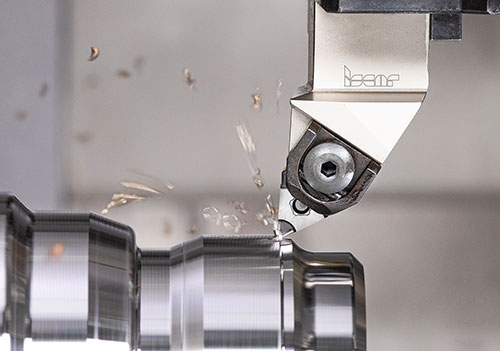 Fig.1
Fig.1
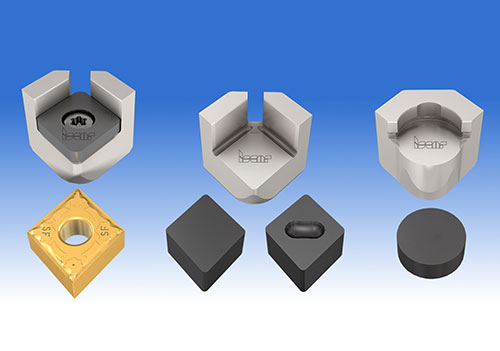 Fig.2
Fig.2
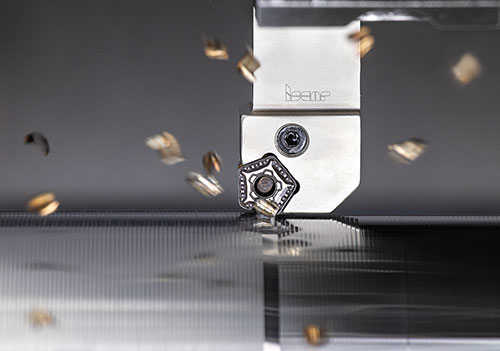 Fig.3
Fig.3
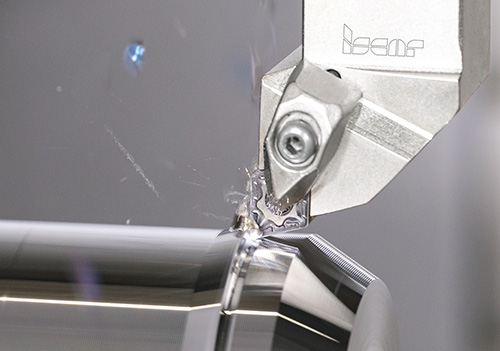 Fig.4
Fig.4
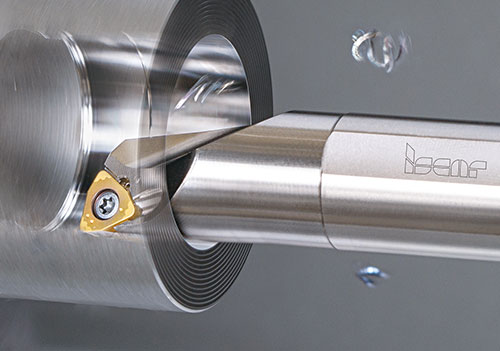 Fig.5
Fig.5